
Harden and Mitchell lift Cavaliers past Pistons in overtime to take 3-2 series lead
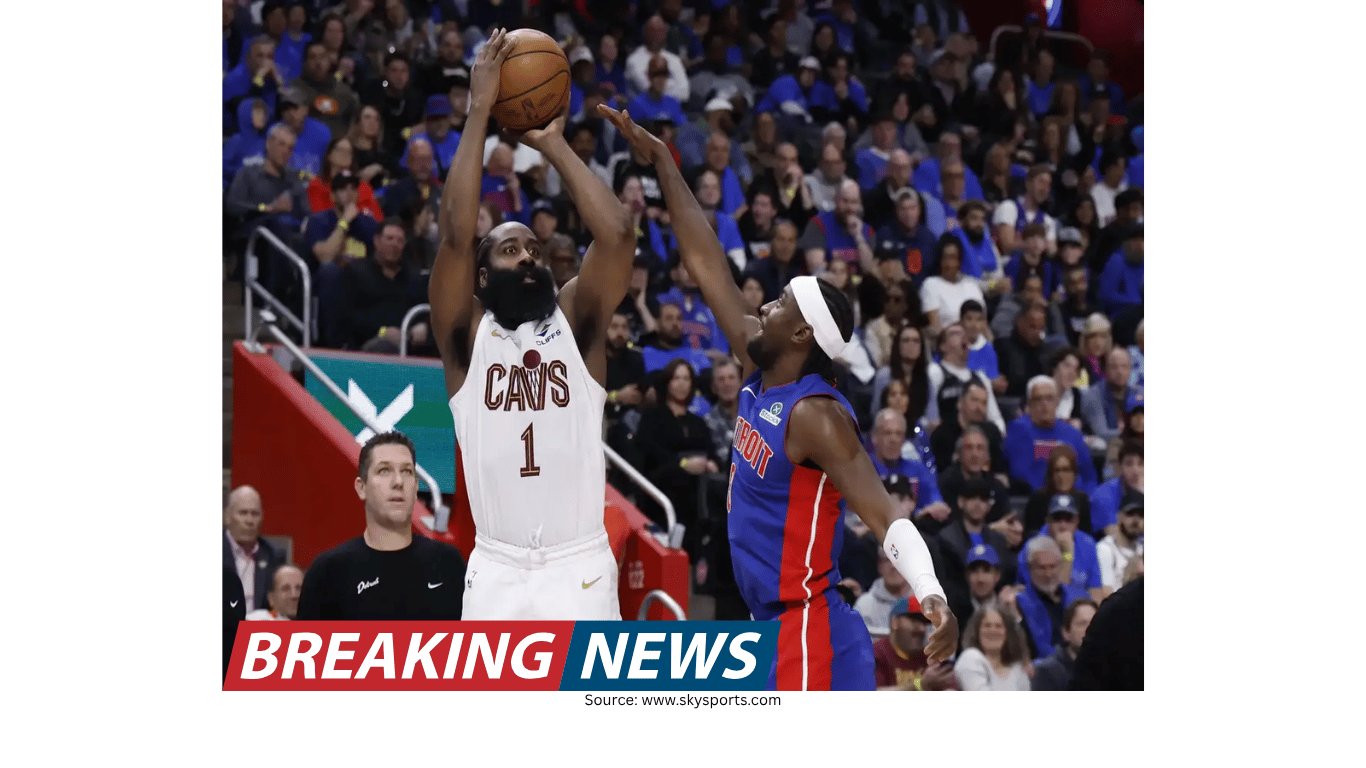
Cavaliers seize control of semi-final series after late comeback
The Cleveland Cavaliers moved to within one victory of the Eastern Conference finals after a dramatic 117-113 overtime win against the Detroit Pistons on Wednesday night. The result gives Cleveland a 3-2 lead in the Eastern Conference semi-finals series and leaves them with two chances to clinch a matchup with the New York Knicks in the next round.
It was a game that swung sharply in momentum: Detroit controlled long stretches, Cleveland looked in trouble late in regulation, and then the Cavaliers produced a decisive finish that carried through overtime. At the center of the turnaround was James Harden, who delivered a playoff-best 30 points, alongside Donovan Mitchell’s 21 in a performance that combined scoring, composure and late-game execution.
Harden’s playoff-best night anchors Cleveland’s response
Harden’s 30 points represented his highest output of the playoffs and came in a contest where Cleveland needed both production and leadership. While the Cavaliers had to dig out of multiple holes, Harden’s scoring helped keep them within reach until the final minutes, when the game began to tilt decisively.
Mitchell, with 21 points, provided another key offensive option, and his shooting became especially significant in overtime as Cleveland turned a tight contest into a controlled finish. Together, Harden and Mitchell gave the Cavaliers the offensive stability required to survive a game in which Detroit held substantial leads and appeared poised to take a 3-2 advantage of their own.
Detroit’s early control: 15-point first-half lead
The Pistons built a strong platform early, leading by as many as 15 points in the first half. That advantage reflected Detroit’s ability to generate offense and put pressure on Cleveland, forcing the Cavaliers to chase the game rather than dictate it.
Even as Cleveland worked to narrow the gap, Detroit maintained enough control to keep the Cavaliers from taking the lead in regulation. The Pistons’ ability to build a cushion twice — first in the opening half and again late in the fourth quarter — made Cleveland’s eventual rally more striking, and set up a tense closing sequence.
A late nine-point deficit and a turning point in the final minutes
With just over two minutes left in regulation, Detroit still looked to be in a commanding position, leading 103-94. At that stage, the Pistons had done the hard work: they had protected their advantage deep into the fourth quarter and put Cleveland in a position where every possession mattered.
But the Cavaliers responded with urgency. The comeback was not a single play, but a sequence of stops and scores that steadily erased Detroit’s advantage. Cleveland’s defense tightened, their execution improved, and the Pistons’ scoring dried up at the worst possible time.
Mobley’s free throws level the game at 103-103
The rally culminated in a 103-103 tie when Evan Mobley made free throws with 45.2 seconds remaining. The moment was pivotal: it not only wiped out Detroit’s late cushion, but also shifted pressure onto the Pistons to find an answer in the closing seconds.
In playoff basketball, late-game possessions often decide outcomes, and Cleveland’s ability to reach parity after trailing by nine so late in regulation underscored both their resilience and their capacity to execute under pressure. The tie set the stage for a finish that would extend beyond regulation.
Cleveland’s defining stretch: a 13-0 run across regulation and overtime
The most decisive statistic of the night came in a stretch that spanned the end of the fourth quarter and the early portion of overtime. Cleveland went on a 13-0 run and held Detroit scoreless for five minutes from late in regulation to midway through the extra period.
That sequence effectively flipped the game. In a contest where Detroit had led comfortably, the Pistons suddenly could not buy a basket, while Cleveland piled on points and created separation. It was the kind of run that often decides playoff games: sustained, multi-possession dominance that leaves an opponent scrambling to regain rhythm.
For Cleveland, it was a reminder of how quickly a game can change when defense locks in and the offense converts at the other end. For Detroit, it was a costly drought that arrived at the most damaging moment possible.
Mitchell’s overtime three opens a cushion
Overtime began with Cleveland carrying momentum, and Mitchell delivered one of the key shots of the extra period. With 2:39 left in overtime, his three-pointer put the Cavaliers up by seven.
In a tight playoff game, a seven-point lead late in overtime is significant, particularly after a defensive run that has already disrupted the opponent’s confidence. Mitchell’s shot did not end the contest on its own, but it reinforced Cleveland’s control and forced Detroit to play from behind under extreme time pressure.
Cunningham’s big night keeps Detroit in range
Despite the loss, Cade Cunningham produced a standout performance for Detroit, finishing with 39 points and nine assists. His output gave the Pistons a consistent source of offense throughout the game and helped them build and maintain leads for long stretches.
Even after Cleveland’s surge, Cunningham continued to push Detroit forward. With 25 seconds left, he made a jumper that cut the Cavaliers’ lead to two points, ensuring the game remained in doubt and that the closing possessions would be played with maximum intensity.
His late basket highlighted both his individual impact and the narrow margins that define playoff outcomes: even after a prolonged scoring drought, Detroit still had a path back into the game in the final seconds.
Harden closes at the line and on the glass
The final moments featured a sequence that captured Harden’s influence beyond scoring. After Cunningham’s jumper brought Detroit within two, Cleveland went to Harden on the ensuing possession. He made one free throw, then rebounded his own miss on the second attempt.
That rebound mattered. It preserved possession and denied Detroit an immediate chance to tie or take the lead. Harden then made another free throw, a final contribution that helped seal the overtime victory.
In a game defined by momentum swings, those small details — a rebound on a missed free throw, a single point at the line — became decisive. Cleveland’s ability to execute in those moments was the difference between letting a comeback slip away and turning it into a series-altering win.
What the 3-2 lead means: Cleveland gets two chances to advance
With the 117-113 overtime win, the Cavaliers now lead the series 3-2. That advantage puts Cleveland in a position of strength: they have two opportunities to secure the series and book a meeting with the New York Knicks in the Eastern Conference finals.
Game 6 is set for Friday night in Cleveland, where the fourth-seeded Cavaliers will have the first of those two chances to close the series. If Detroit responds and wins Game 6, the series would go to a decisive Game 7 on Sunday, hosted by the top-seeded Pistons.
Key game notes at a glance
- Cleveland won 117-113 in overtime to take a 3-2 lead in the Eastern Conference semi-finals series.
- James Harden scored a playoff-best 30 points; Donovan Mitchell added 21.
- Detroit led by 15 in the first half and was ahead 103-94 with just over two minutes left in regulation.
- The Cavaliers tied the game at 103-103 on Evan Mobley’s free throws with 45.2 seconds remaining.
- Cleveland went on a 13-0 run and kept Detroit scoreless for five minutes spanning late regulation and early overtime.
- Mitchell’s three-pointer with 2:39 left in overtime put Cleveland up seven.
- Cade Cunningham posted 39 points and nine assists, cutting the deficit to two with 25 seconds left.
- Harden made late free throws and rebounded his own missed attempt in the closing seconds.
- Game 6 will be played Friday night in Cleveland; if needed, Game 7 would be Sunday in Detroit.
A series that continues to swing on late-game execution
This matchup has now produced a pivotal Game 5 defined by late execution and composure. Detroit had built the kind of lead that typically closes out a playoff game, particularly when holding a nine-point advantage with just over two minutes remaining. Yet Cleveland’s response — tying the game, then controlling overtime — demonstrated how quickly a contest can turn when one team strings together stops and timely shots.
The Cavaliers’ late defensive stand, highlighted by keeping Detroit scoreless for five minutes, was the backbone of the comeback. Offensively, Harden’s scoring night and Mitchell’s key overtime three provided the finishing touches, while Mobley’s late free throws ensured the rally reached the point where overtime became possible.
For Detroit, Cunningham’s 39-point effort showed the Pistons have the firepower to win in this series, and the fact they were within two points in the closing seconds of overtime underlined how close the game remained even after a damaging drought. But the Pistons will now need to regroup quickly with the series shifting back to Cleveland for Game 6.
Next up: Game 6 in Cleveland
The schedule now places the spotlight on Friday night, when Cleveland hosts Game 6. The Cavaliers, as the fourth seed, will aim to use home court to finish the job and move on to face the New York Knicks in the Eastern Conference finals.
Detroit, the top seed, faces a clear task: extend the series. A Pistons win would force a Game 7 on Sunday in Detroit, setting up a winner-take-all finale. After a Game 5 that swung dramatically in the final minutes, both teams will enter the next contest knowing that a few possessions — and the ability to execute under pressure — can again decide everything.