
Tyson Fury returns with points win over Arslanbek Makhmudov as Anthony Joshua rivalry flares again
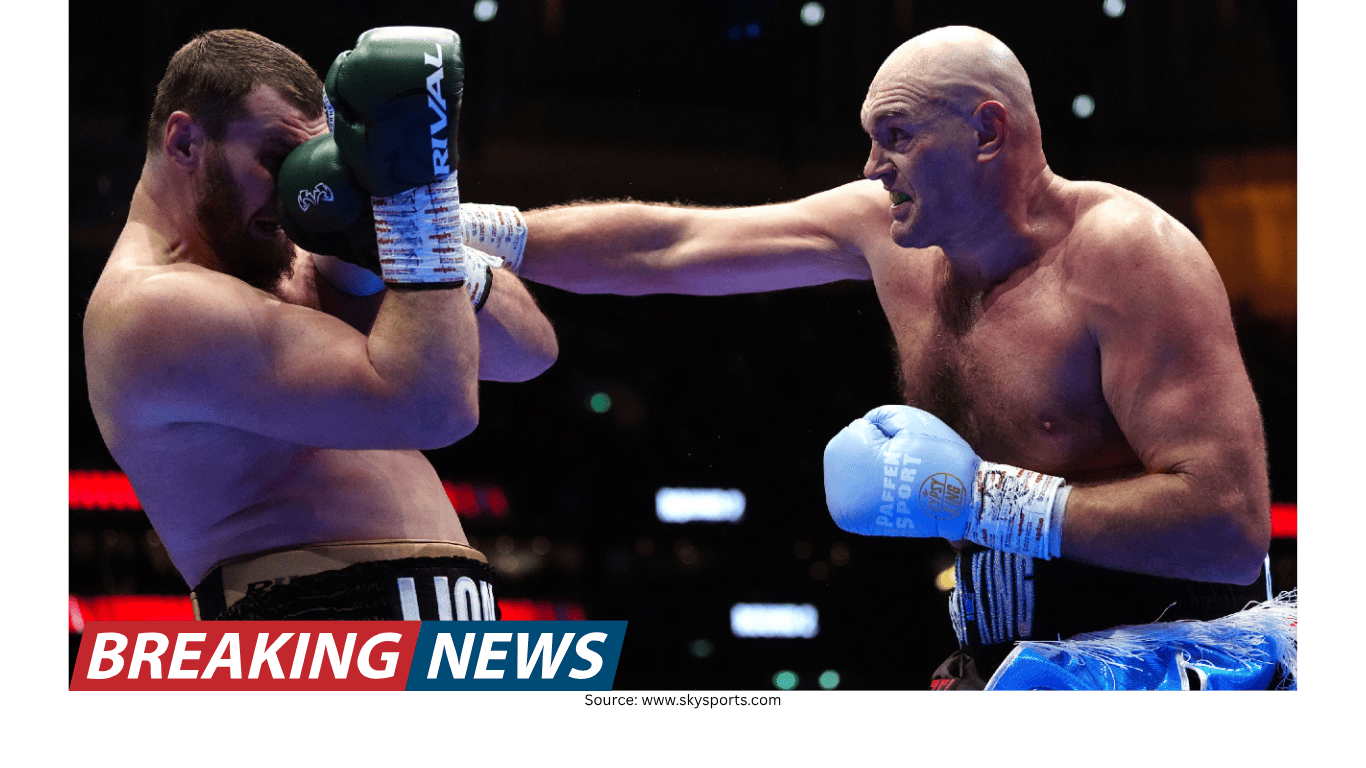
Fury’s comeback night in London ends with a clear decision
Tyson Fury returned to the ring after a 16-month retirement and marked the occasion with a unanimous decision win over Arslanbek Makhmudov at Tottenham Hotspur Stadium in London. The scorecards reflected a one-sided contest: two judges had it 120-108, while the third scored it 119-109.
The result was significant not only because it ended Fury’s time away from boxing, but because it unfolded under the gaze of Anthony Joshua, Fury’s long-time rival, who watched from ringside. With the event framed as a major moment for British boxing, the night felt designed to move Fury back into the centre of the heavyweight conversation.
Context: a return after 16 months away
Fury had stepped away from the sport for 16 months following two losses to reigning world champion Oleksandr Usyk. At 37, Fury knows time is no longer an abstract concept in a heavyweight career, and the atmosphere inside the stadium underlined why he chose to come back.
For his opponent, Fury selected Makhmudov, described as strong but predictable. It was a matchup that offered risk—Makhmudov is known for being dangerous early—while still giving Fury a platform to show he could control a fight again after a long layoff.
An emotional entrance and a stadium-ready spectacle
Fury’s first contest in a British ring since 2022 began with an emotional tribute to Ricky Hatton, the British boxing legend who died last year. Fury used Hatton’s signature “Blue Moon” music and wore shorts in Hatton’s style, turning his ringwalk into a personal moment before the action began.
That sombre opening quickly shifted into a full stadium spectacle. Fireworks and flames burst around Fury as he stood before the crowd on a raised platform. He danced, grinned, and visibly fed off the energy. The reception underlined the draw he still holds in Britain, and it added weight to the sense that this was not simply a comeback bout but a statement of intent.
Makhmudov starts fast, trying to test Fury early
From the opening bell, Makhmudov charged forward, leaning into the reputation that he can be dangerous in the early rounds. Fury, moving back in straight lines, allowed himself to be driven toward the ropes at times. The Russian swept a right hand toward Fury in the first round, creating moments of threat even if the attacks were described as frantic and clumsy.
Those rushes forced Fury to spend the early stages taking measure of his opponent and establishing control. The first round, in particular, had the look of a fighter returning from a long break: reading distance, absorbing the tempo, and gradually working out how to neutralise the pressure.
Fury begins to find timing and punish mistakes
In the second round, Makhmudov wandered out of position after a wild attack. Fury responded by smacking punches into him, triggering a huge roar from the crowd. Another punch brought another cheer, and by the end of the session Makhmudov was shrugging his head and neck, trying to shake off the effects.
The third round offered a clearer glimpse of Fury’s control. He lashed a one-two and began to move onto the front foot behind a fierce jab. Fury landed a right hook as Makhmudov threw at the same time, and for a moment Makhmudov’s legs appeared to buckle. Fury smiled as he leaned on him, a small but telling sign that he felt the fight turning in his favour.
Clean counters and a growing sense of command
Makhmudov did have moments. In the fourth round, he caught Fury with his left. But when Makhmudov lunged in and stranded himself on the ropes, Fury took advantage. He lined up a crunching right cross that slammed into the side of Makhmudov’s head, reinforcing the pattern of the fight: Makhmudov’s forward surges creating openings that Fury could exploit with cleaner, more accurate work.
As the bout moved into the second half, the fighters touched gloves, and the contest settled into a rhythm that suited Fury. He had found the measure of his opponent and was increasingly able to dictate where and how exchanges happened.
Jabs, clinches, and inside work shape the middle rounds
Makhmudov continued to trundle forward, but Fury marked him out with reliable left jabs. The big men slammed together in clinches, and Fury was effective on the inside. At one point he bounced Makhmudov’s jaw aside with a tight left hook, a reminder that he could hurt his opponent without needing to overcommit.
In the eighth round, Fury picked out a long lead hook and pressed Makhmudov back, but he did not rush himself. The approach was measured: keep Makhmudov at range when possible, tie him up when necessary, and punish him when he overextended.
Late exchanges and a slip to the canvas
The closing rounds brought more action. At the end of the 10th round, the fighters traded fiercely, and Makhmudov wearily lost his footing, slipping down to the canvas. Just before the bell, Fury shook him with a right and then a left hook to the chin, adding emphasis to a round that already felt like it belonged to the returning fighter.
In the 11th, Fury switched southpaw momentarily. He flapped his jab into Makhmudov, attacked the body, and then brought an uppercut through to the head. He turned Makhmudov into a corner but could not find a finishing touch. A hard left hook from the southpaw stance drew another gasp from the crowd, yet Makhmudov lasted the course.
Wide scorecards reflect Fury’s control
When the final bell sounded, the sense of the contest was clear. Fury had almost scored a shutout win on the cards, taking a wide unanimous decision. The numbers—120-108 twice and 119-109 once—captured how consistently he had outworked and out-positioned Makhmudov after the early pressure.
For Fury, the win served as proof that he could return from a lengthy break and still deliver a disciplined performance in front of a major crowd. For Makhmudov, it was a night where forward momentum and physical strength were not enough to overcome cleaner technique and ring management.
Joshua watches from ringside as talk of a mega-fight grows
Joshua’s presence was more than a celebrity cameo. Earlier in the evening, Saudi financier Turki Alalshikh, who was staging the event, teased that “the biggest fight in the history of England” between Fury and Joshua was on the brink of being made. That framing hung over the night, turning Fury’s comeback into a potential launching pad for a much bigger occasion later in the year.
Fury himself appeared to be fighting with that possibility in mind. The bout was described as part of an effort to prolong his career and to snare what could be the richest prize of his whole career later in the year.
Post-fight: Fury calls out Joshua directly
No sooner was the decision announced than Fury addressed Joshua. In a booming voice to the stadium, he said: “Next, I want to give you the fight you’ve all been waiting for.”
He then bellowed down to his rival: “I want you, AJ, Anthony Joshua. Let’s give the fight fans what they want - the Battle of Britain. I challenge you Anthony Joshua to fight me the Gypsy King next.”
Joshua responds: ‘You are a clout-chaser’
Joshua did not let the moment pass quietly. He replied: “Tyson, you are a clout-chaser. I’ve never had no problem getting in a ring with you, I punched you up as kids [when they sparred]. Watching you tonight I’ll punch you up again.”
Joshua continued, while acknowledging the occasion belonged to Fury: “With all due respect, tonight is your night. You won’t tell me what to do. I’ve been chasing you the last 10 years, when you’re ready you come and see me and tell me your terms and conditions.”
He finished with a final flourish: “I’m the boss, you work for me. I’m the landlord. You work for me.”
What the fight showed—and what it set up
Fury’s win over Makhmudov delivered what comeback fights are meant to deliver: rounds, rhythm, and a clear result. After early moments where Makhmudov’s aggression forced Fury backward, Fury’s jab, timing, and ability to capitalise on mistakes took over. The later rounds, including the brief southpaw switch, suggested a fighter comfortable enough to vary his approach while maintaining control.
But the bigger story may be what happened after the final bell. With Joshua in the building and both men trading words in public, the event served as a stage for the rivalry that has long hovered over the heavyweight scene in Britain. The talk of “the biggest fight in the history of England” may remain a tease until contracts are signed, but on this night the narrative moved forward in front of a packed stadium.
Key moments from Fury vs Makhmudov
- Fury returned after 16 months away and won by unanimous decision (120-108, 120-108, 119-109).
- Makhmudov started aggressively, pushing Fury toward the ropes early.
- Fury established control with jabs, clean counters, and effective clinch work.
- Late in the fight, Fury briefly switched southpaw and landed a hard left hook that drew a crowd reaction.
- Immediately after the decision, Fury called out Joshua; Joshua responded with sharp words of his own.