
Dembele double ends Liverpool’s Champions League run as PSG progress 4-0 on aggregate
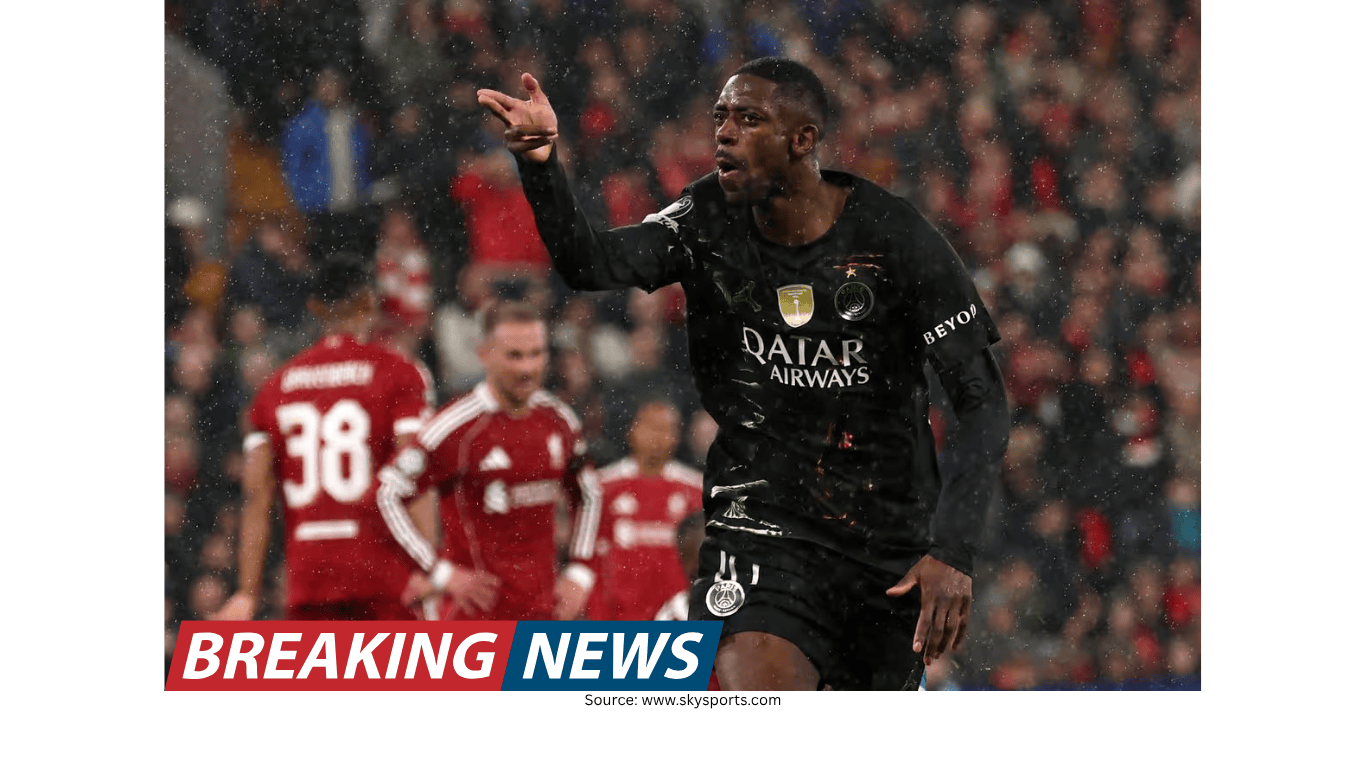
Liverpool’s Champions League campaign came to an end at Anfield as Paris Saint-Germain secured a 2-0 win on the night to complete a 4-0 aggregate victory in the quarter-finals. Ousmane Dembele struck twice in the second half to confirm PSG’s passage into the last four and to close the door on the home side’s hopes of an Anfield comeback.
Arne Slot’s team arrived needing to overturn a two-goal deficit from the first leg in Paris, and the atmosphere suggested belief was possible. Liverpool played with intensity and purpose for long spells, unsettling the European champions and forcing moments of defensive urgency. But the tie ultimately followed the pattern set in the first leg: Liverpool created opportunities without taking enough of them, while PSG were clinical when the decisive moments arrived.
A night that began with belief
With the home crowd pushing Liverpool forward, the early phases were played at a high tempo. Slot’s side pressed aggressively and looked to force PSG into hurried decisions. The plan was clear: play on the front foot, sustain pressure, and try to generate the kind of momentum Anfield is known for on European nights.
Liverpool did create chances that could have shifted the tie. Virgil van Dijk came close in the first half, only for Marquinhos to make a crucial clearance from near the line. It was the type of intervention that can define a knockout contest, and it underlined PSG’s ability to survive under pressure.
Another pivotal moment arrived when Alexis Mac Allister went down in the area and a penalty was initially awarded for a foul by Willian Pacho. After a VAR review, the decision was overturned. The contact was described as soft, but the reversal remained a major talking point. For Liverpool, it was a moment that could have changed the emotional direction of the game; for PSG, it was a reprieve.
Dembele’s decisive impact
As Liverpool pushed for the breakthrough, PSG’s composure and precision became increasingly influential. The visitors absorbed pressure and waited for openings, aware that Liverpool’s need to chase the tie would inevitably create space. Dembele took advantage late on, scoring twice in the second half to settle the contest and confirm PSG’s progress.
Even on an awkward night, PSG’s sharper execution proved the difference. Dembele’s finishing ensured there would be no late twist, and he was named player of the match for his contribution.
PSG’s reward is a place in the semi-finals, where they will face either Bayern Munich or Real Madrid. Luis Enrique’s side also extended a run of form, reaching a six-game winning streak for the first time this season, a sign of a team finding rhythm at a crucial stage.
Liverpool’s chances and the familiar problem
The final scoreline did not fully capture how competitive Liverpool were for long periods. They registered 21 shots against PSG, but only five of those forced saves. The volume was there; the cutting edge was not. The pattern was described in simple terms: a sloppy pass, a wild finish, a poor decision, and moments of hesitation when conviction was required.
Slot referenced an ongoing theme, pointing to underperformance in front of goal. Liverpool came into the match having scored 24 goals from an expected-goals total of 27.8 in the Champions League this season, making them the biggest underperformers among the eight quarter-finalists. The second leg followed a similar storyline: enough pressure to make PSG uncomfortable, but not enough precision to turn that pressure into goals.
There were also individual frustrations within the broader team story. Mohamed Salah was introduced before the break after an injury to Hugo Ekitike, and while the intent remained, the match assessment suggested physical limitations. Florian Wirtz was described as having missed an opportunity to deliver in a defining moment, while Alexander Isak was noted as still short of fitness.
Slot’s selections and in-game gambles
Slot’s approach reflected the scale of the task. He started Isak and later made attacking changes, including bringing on Salah for Ekitike before half-time. Another notable switch came when Joe Gomez was replaced by Rio Ngumoha, a move that raised the volume inside Anfield and briefly fed the sense that a classic turnaround might still be possible.
Those decisions aligned with the team’s performance: Liverpool took risks, played with aggression, and tried to turn the tie into a contest of momentum. But in knockout football, risk can be punished when the opponent has the quality to exploit transitions, and PSG eventually did exactly that.
The injury concern for Ekitike
One of the most concerning moments of the night came in the first half when Ekitike went down. He attempted to continue but fell again, clutching what appeared to be his Achilles. The reaction around him suggested immediate worry, including from PSG players.
Slot addressed the incident afterwards, making clear that the initial signs were not positive while also stressing that further assessment would be needed.
“It looks really bad but it is difficult for me to say how bad,” Slot said in his press conference. “Tomorrow we will investigate this further how bad this is for him. Let’s see but that it doesn’t look good is clear.”
The VAR moment that framed the debate
The overturned penalty decision became a central post-match discussion point. While there was acknowledgement that the initial award was soft, Liverpool’s camp felt the intervention went against them at a key moment.
Ibrahima Konate was emphatic in his view of the incident, arguing that Liverpool were denied a chance to change the tie’s direction.
“For me it was a clear penalty,” Konate said. “I was behind the referee. If we get the penalty and score it would have been completely different.”
From the studio perspective, the incident was also debated in terms of contact and entitlement. Tim Sherwood, analysing the match, argued that there was enough in it to justify the original decision.
“I still think it was a penalty. There was contact into the back of the leg. He is entitled to go down with that contact,” Sherwood said.
Sherwood also offered a broader assessment of the tie, praising Liverpool’s performance on the night while suggesting the damage had been done in the first leg.
“Liverpool were the better team tonight. If they play like that, they will 100 per cent qualify for the Champions League. This tie was lost in the first leg. Why didn’t they go over there and have a go?” he said.
Luis Enrique: PSG had to suffer, and they did
PSG head coach Luis Enrique credited Liverpool’s intensity and acknowledged that his side had to endure difficult phases, particularly as the match progressed.
“Liverpool played a fantastic game, real intensity. In the second half, when things turned around, things got even tougher for us,” he said. “We showed what kind of team we are, Liverpool showed what kind of team they are too. It was a great quarter-final.”
He also highlighted how fine margins can shape a knockout tie, suggesting that conceding early would have changed the challenge significantly.
“Good luck is important. Had we conceded a goal early in this game, it would have been difficult so you need things to go your way,” Luis Enrique said.
With Liverpool committing players forward, PSG’s counter-attacking threat became more relevant, and Luis Enrique described that as part of the game plan that emerged from the match situation.
“They had to take a lot of risks and that meant we could launch a counter-attack and kill the match off,” he said. “It took us longer than I would have liked for us to do that. I would have liked us to do it earlier.”
In a notable concession, he also felt Liverpool had done enough to deserve a goal over the course of the match, even if the scoreboard never reflected it.
“We knew they would create problems for us, we knew we would have to suffer at times. Liverpool definitely deserved to score, I think, over the course of the game,” he said.
Slot: effort, atmosphere, and a lack of reward
Slot’s post-match comments focused on the work-rate of his players and the role of the crowd in driving Liverpool’s pressing game. He framed the performance as one that had elements to be proud of, while also returning to the frustrations that have defined parts of the season.
“I have to give a lot of credit to the players, how hard they worked. I have to give a lot of credit to our fans, how they helped us tonight to execute our game plan,” Slot said.
He explained how the crowd’s energy supported Liverpool’s high press and helped sustain the team’s intensity.
“And that means if we have a high press it’s so helpful if there are fans behind you to keep on pushing you, pushing you, pushing you. That’s what they did,” he said.
But Slot also pointed to the lack of finishing as a recurring issue, alongside the injury and the VAR decision.
“Unfortunately, it’s one of the many examples of this season where we weren’t able to score from the many chances we had,” he said. “Again, we were so far underperforming in terms of xG and that is just an ongoing thing with us throughout the whole season.”
He added: “And add to that, as it seems to be, a bad injury [to Ekitike], we don’t know for sure yet. Add to that another intervention of the VAR which was not in our favour and that is not for the first time this season.”
Slot described a period in the second half when Anfield sensed the match could tilt decisively, only for Liverpool to be unable to take that step.
“Then, of course, we are very disappointed because I think there were parts in the second half where you could just feel that we can score now and this is going to become a special night,” he said.
What the result means for both clubs
For PSG, the victory confirmed their place among the final four and continued a run of wins that suggests improving momentum. They managed the tie with discipline, defended key moments, and then used their quality to finish it when Liverpool’s risks increased.
For Liverpool, the elimination confirmed a trophyless campaign. While the performance contained encouragement in terms of intensity and endeavour, the outcome reinforced the harsh reality of knockout football: chances must be taken, and moments must be seized.
The focus now shifts to domestic objectives. With the Champions League campaign over, Liverpool’s priority becomes securing a return to the competition by finishing in the Premier League top five this season.
Player ratings and standout performers
- Liverpool: Mamardashvili (6), Frimpong (6), Konate (7), Van Dijk (6), Kerkez (6), Gravenberch (7), Mac Allister (6), Szoboszlai (7), Wirtz (6), Ekitike (6), Isak (5). Subs: Salah (6), Gakpo (7), Gomez (6), Ngumoha (7), Jones (6).
- Paris Saint-Germain: Safonov (7), Hakimi (7), Marquinhos (7), Pacho (6), Mendes (6), Joao Neves (6), Vitinha (7), Zaire-Emery (6), Doue (6), Dembele (8), Kvaratskhelia (6). Subs: Hernandes (6), Barcola (7), Beraldo (n/a).
- Player of the match: Ousmane Dembele.
In the end, Liverpool’s night was defined by effort and pressure without the decisive finish, while PSG’s was defined by resilience and the sharpness of Dembele when it mattered most. The aggregate scoreline was emphatic, even if the second leg itself contained long stretches where Liverpool made the contest feel far closer than the final outcome suggested.