
England held 1-1 by Uruguay as Ben White’s comeback becomes the night’s defining story
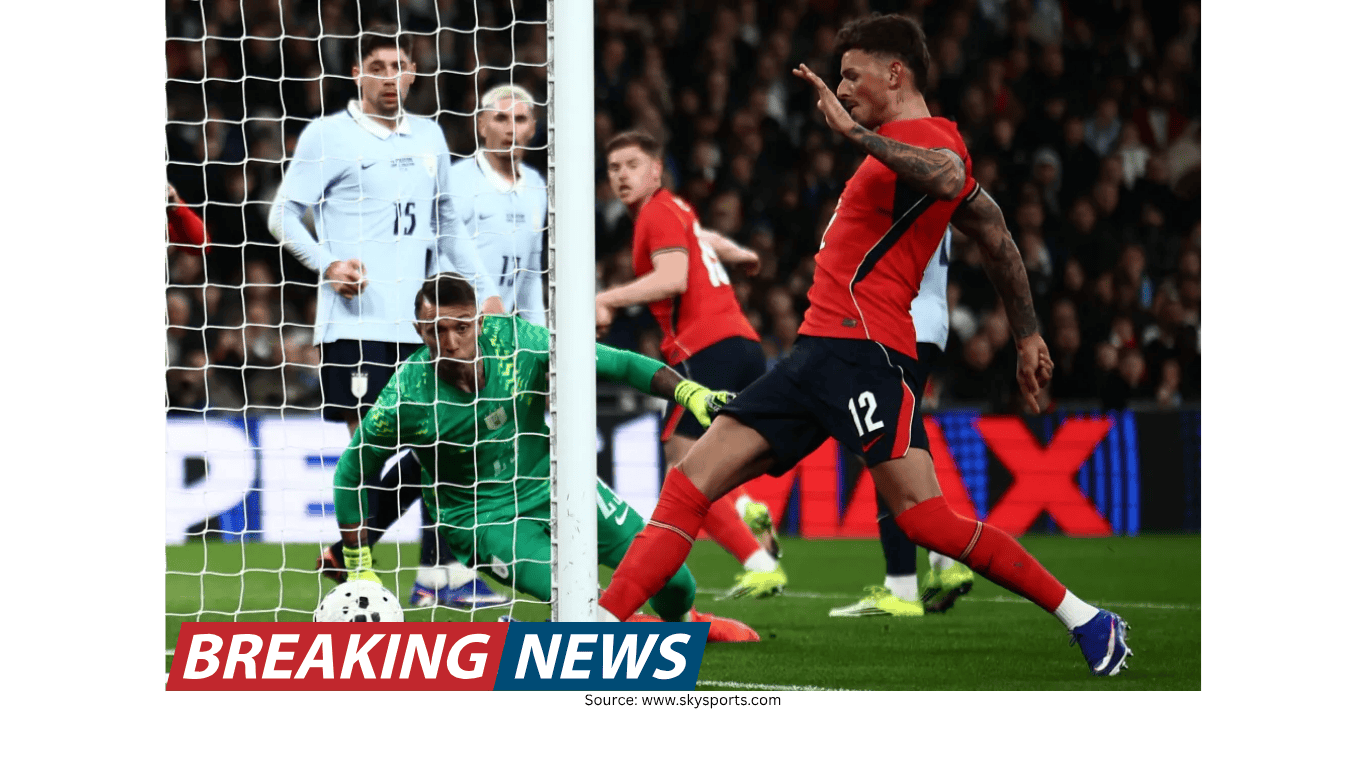
White’s return to Wembley ends with applause, boos and a late twist
England’s 1-1 friendly draw with Uruguay at Wembley was framed as an opportunity: a night for players to make their case to Thomas Tuchel and push themselves into contention for future international selection. Instead, it became a match dominated by one storyline, one player and one moment that changed the mood of the stadium in stoppage time.
Ben White, returning to the England setup after a long absence, scored his first international goal and then conceded the penalty that allowed Uruguay to equalise in the 94th minute. The defender’s involvement in both decisive moments ensured he remained at the centre of attention from the moment he stepped onto the pitch, and the reaction from sections of the Wembley crowd underlined how charged his comeback remains.
In front of an attendance of 80,581, England led late thanks to White’s close-range finish. Yet the match ended level after a VAR review judged White to have fouled Federico Viñas, allowing Federico Valverde to convert from the spot. The final whistle was met with audible frustration, not only about the late concession but also about a performance that, for long spells, struggled to ignite.
A mixed reception before the first touch
White’s reintroduction to the international stage carried context well beyond the 90 minutes. Called up to the squad as a replacement for Jarell Quansah, his selection was controversial, and Tuchel acknowledged beforehand that the defender would have to “clear the air” with team-mates after leaving the 2022 World Cup early for personal reasons. White later rejected a call-up under Gareth Southgate following a disagreement with then assistant coach Steve Holland.
That self-imposed international exile ended when Tuchel took charge, but the Wembley crowd made clear that not everyone was ready to move on. White was booed when he came on as a second-half substitute, a reaction that set the tone for the rest of his night.
Tuchel said he was disappointed by the mixed reception. “I heard he was booed,” he said, adding that he did not hear it clearly on the field because he was focused on substitutions. “There were some groups [who gave him a] mixed reception which I’m disappointed about because we protect our players. He needs to take it on the chin. Hopefully he can put it behind him because he’s ready to write some new chapters.”
A goal that should have been a release, but wasn’t
England’s breakthrough arrived late and in scruffy fashion. After a night in which the home crowd had “little to shout about”, White found himself at the back post and tapped in from close range for his first England goal.
Normally, a first international goal is a moment of pure celebration, a release of tension and a reward for persistence. Here, it was complicated. White’s celebration played out to a soundtrack of jeers from some in the stands, and when the stadium announcer read his name, the boos returned loudly.
The goal did briefly lift Wembley, but it did not transform the match. England remained short of fluency, and the wider sense persisted that this was an evening in which multiple players were being tested without many truly taking control of their audition.
VAR intervention and a stoppage-time equaliser
Just as England seemed set to see out a narrow win, the match turned in stoppage time. A VAR check led to a penalty being awarded against White for a foul on Viñas. Valverde stepped up and scored in the 94th minute to make it 1-1.
White’s involvement in the incident was described as unlucky, with his outstretched boot arriving a fraction of a second after the striker went for what was effectively a 50-50. Still, the decision stood, and Uruguay took the chance to level.
The reaction inside Wembley was layered. There were boos aimed at the officials after the VAR review, and there was also a broader disgruntlement at full-time that reflected dissatisfaction with England’s overall display. For those who had booed White earlier, the late concession ensured the night ended on a sour note.
Officiating controversies add to the sense of a fractured evening
Beyond the late penalty, the match was also marked by a series of incidents that left England’s camp unhappy with the officiating. Ronald Araújo escaped a red card for a bad tackle on Phil Foden, and there was confusion around Manuel Ugarte appearing to be shown two yellow cards without being sent off.
Harry Maguire later described the penalty decision as “ridiculous” and offered an explanation of the yellow-card confusion. “We’ve been told Ugarte was shown two yellow cards and the second one was rescinded, which is new one on us,” Maguire said. “Now we’ve been told the first of those yellow cards for Ugarte was actually for [José María] Giménez. So rather than two yellow cards, Ugarte got no yellow cards.”
Tuchel was also critical. He called the penalty “very soft”, arguing that while there was contact, it was “so obvious what the striker is trying to do.” He questioned why some incidents were not reviewed and others were. “I was surprised the VAR was in place - I thought it wasn’t working,” he said, referencing the tackles on Foden and Noni Madueke. “Then suddenly this one is checked.”
Tuchel added: “I didn’t think it was a good performance at all [from the officials]. A bad day at the office.”
An audition that left more questions than answers
The match had been billed, implicitly, as a chance for players to stake a claim for future selection. The sense at full-time was that few did so convincingly. England were described as underwhelming “individually and as a unit”, and the performance did not provide the clarity a coach typically wants from a trial run.
There were positives. Maguire’s return after a long absence was noted as assured, and he even wore the captain’s armband for the final 30 minutes. Late on, he produced a significant block deep into injury time that helped avert defeat.
James Garner’s debut was also viewed as a plus, with his contribution described as neat and unfussy. Elsewhere, there were moments that stood out for the wrong reasons: Dominic Calvert-Lewin miscued a header with the goal gaping, a painful miss for a substitute striker trying to impress in a context where opportunities were limited.
Phil Foden again did not deliver in an England shirt, and his evening ended after a heavy challenge that left him limping. Madueke was forced off after a heavy first-half challenge. In the broader picture, the match left Tuchel with “more questions than answers” about who can step up when the stakes rise.
England’s line-up and the shape of the night
England’s selection included Dean Henderson in goal, with Dan Burn, Marc Guéhi, Ezri Konsa and Nico O’Reilly listed among the defenders. The midfield options included Elliot Anderson, Declan Rice and Morgan Rogers, while Anthony Gordon, Harry Kane and Bukayo Saka were listed among the forwards.
Even with recognisable names on the teamsheet, the match itself was described as “pretty flat and lacking in purpose” for long periods. England’s goal came from a “messy set-piece”, and the overall attacking play did not consistently create clear chances. That context made the late penalty all the more significant: the margin for error was small because the lead had never felt secure.
White’s night: a snapshot of the pressure around England selection
White’s evening captured the intensity that surrounds England selection, particularly when personal history and public perception collide. From the moment he entered as a second-half substitute, the crowd response ensured his every involvement would be scrutinised. Scoring should have changed the mood permanently; instead, it amplified the divide.
For Tuchel, the match offered a real-time lesson in what it means to reintegrate a player under the glare of Wembley. He spoke about protecting players and urged White to take the reaction “on the chin”. Yet the episode also served as a reminder that international football is not only about tactics and form, but also about managing narratives that can follow players onto the pitch.
The late penalty, whether viewed as harsh or inevitable, compounded the emotional swing. White delivered the moment that put England ahead, then was directly involved in the moment that took the win away. In a friendly designed to test options, it was an outcome that felt unusually loaded.
What Tuchel said about the performance
Tuchel’s assessment of England’s approach was more positive than the mood in the stands suggested, even as he criticised the officiating. He said: “I liked the positivity, the attitude, the performance. Everyone was always ready to adapt to the questions asked by us. It was a very tactical game.”
He also reflected on the difficulty of turning control into momentum without a second goal. “In the moment we were very good we didn’t get the goal to get a bit more freedom in our game. The boost was missing but we kept trying,” he said.
Those comments indicated a coach looking for building blocks rather than perfection. Still, the late equaliser and the controversies around key decisions ensured the post-match discussion was dominated by what went wrong, not what could be taken forward.
Next steps: another Wembley friendly and final assessments
England’s schedule continues with another friendly at Wembley, against Japan on Tuesday, with a 7.45pm kick-off. It will be the final chance for Tuchel to assess players on the international stage before he announces his World Cup squad at the end of the season.
After that, England have warm-up matches scheduled with New Zealand and Costa Rica before their tournament opener against Croatia on June 17.
For players on the fringes, the message from the Uruguay match is clear: opportunities can be rare, and moments can define an evening. White experienced both extremes in the space of 13 minutes, and England as a whole were left to reflect on a match that promised clarity but delivered complication.
Key talking points from England 1-1 Uruguay
- Ben White’s comeback: booed when introduced, he scored his first England goal and then conceded the stoppage-time penalty.
- Late VAR drama: a 94th-minute spot-kick, converted by Federico Valverde, denied England victory.
- Officiating disputes: England were unhappy about the penalty decision and other incidents, including challenges on Phil Foden and Noni Madueke and confusion over Manuel Ugarte’s bookings.
- Auditions under scrutiny: with places up for grabs, the overall performance was viewed as underwhelming, though there were positives including Harry Maguire’s assured return and James Garner’s debut.
In a match that was meant to be a calm checkpoint on the road ahead, Wembley instead witnessed a friendly that felt unusually tense. England left with a draw, but also with unresolved debates: about selection, about refereeing, and about how quickly a player’s international story can be rewritten—or reopened—under the stadium lights.