
Carragher: Rodri and Bernardo Silva’s bravery decided the midfield battle as Man City beat Arsenal
City’s win reshapes the title picture
Manchester City’s 2-1 victory over Arsenal at the Etihad Stadium has tightened the Premier League run-in and, in Jamie Carragher’s view, provided a clear tactical lesson about how elite matches can be decided away from the penalty areas. The result moved Pep Guardiola’s side to within three points of Mikel Arteta’s league leaders, with City also holding a game in hand. With the season approaching its final stretch, Carragher described the performance as one that set up a “thrilling finale” to the campaign.
On Monday Night Football, Carragher’s analysis focused less on isolated moments and more on the patterns that shaped the match: Arsenal’s early pressing success, City’s response through their central midfielders, and the contrasting comfort levels the two teams showed when trying to play out from the back under pressure.
Carragher’s central claim: the match was won in midfield
Carragher’s headline conclusion was blunt: “The game was won in midfield.” In his assessment, the decisive edge came from Manchester City’s experienced pairing of Rodri and Bernardo Silva, who he said “outsmarted” Arsenal’s Declan Rice and Martin Zubimendi. Carragher went further, calling it one of the best combined midfield performances he could remember seeing in the Premier League.
Rather than framing the contest as a simple battle of energy or physicality, Carragher highlighted decision-making under pressure: who demanded the ball, who could receive it in difficult areas, and who could turn defensive situations into controlled attacks. The match, as he presented it, became a study in how composure and positioning can neutralise an aggressive press.
Arsenal’s press started fast — and it worked
Arsenal began with an effective press, and Carragher backed that up with a specific early metric: they won possession in the final third six times inside the opening 15 minutes. He noted that this was the most any side has managed in the Premier League this season, underlining both the intensity of Arsenal’s start and the scale of the problem City had to solve.
In Carragher’s breakdown, Arsenal’s early approach put immediate stress on City’s usual build-up routes. With Rice and Martin Odegaard pushing aggressively, Carragher argued City initially struggled to feed the ball into their preferred players in central areas. The pressure, at least at the start, forced City into moments of discomfort and led to at least one early turnover involving Bernardo Silva.
But Carragher’s point was that the press itself was not the story; the response to it was. Arsenal’s early success created a tactical question: would City avoid risk and go longer, or would they keep insisting on playing through the pressure?
City’s adjustment: Rodri and Silva drop deeper to take control
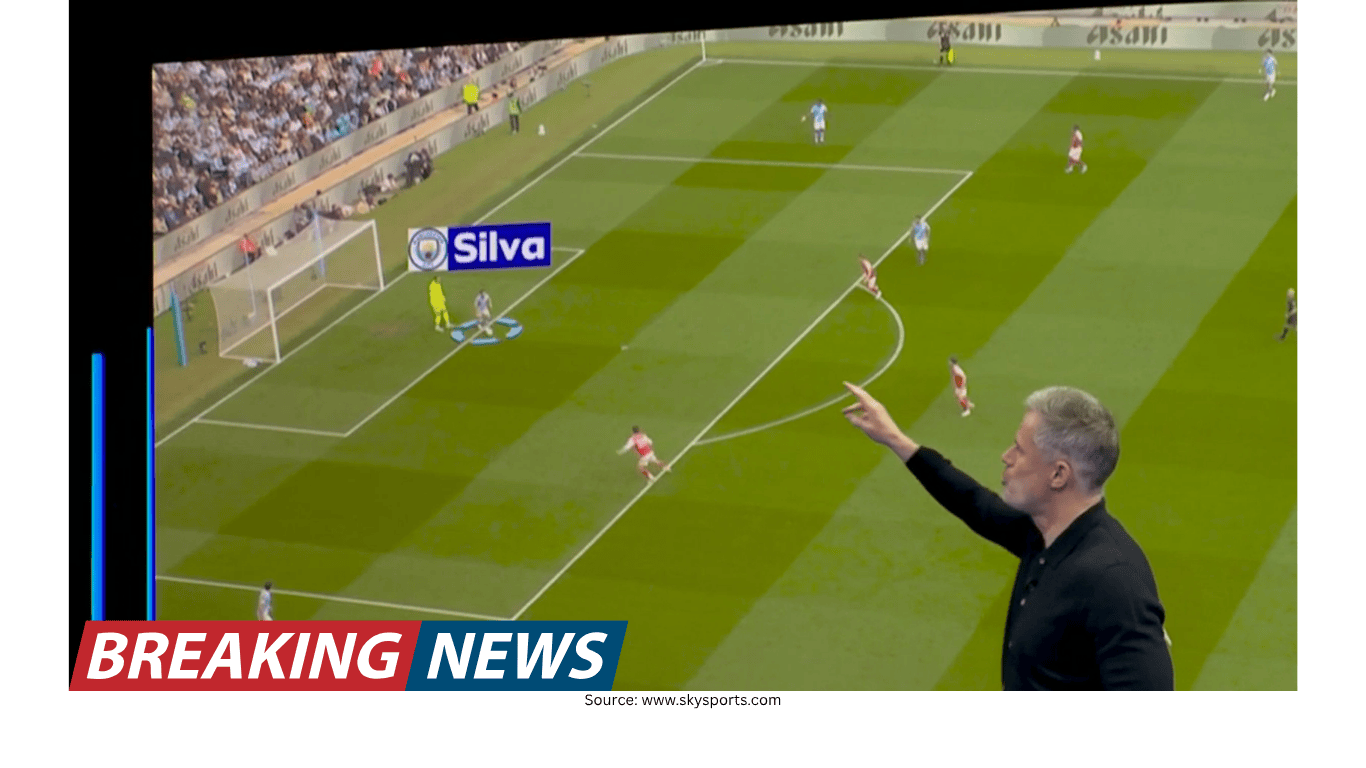
Carragher said the match changed when Rodri and Bernardo Silva began dropping deeper to receive the ball and help City play out. In his words, the pair “ended up in the back four,” effectively behaving like additional centre-backs in possession. The aim, as Carragher described it, was to create better angles, invite pressure, and then play through it rather than around it.
He framed this as a form of problem-solving: City recognised that Arsenal’s midfield pressure was preventing clean progression, so Rodri and Silva moved closer to the goalkeeper and defenders to ensure City could still build attacks with control. Carragher saw this as a proactive move that not only solved City’s immediate issue but also posed a new one for Arsenal, who now had to decide whether to follow them deep or hold their shape and allow City time on the ball.
Carragher also emphasised the psychological side of the adjustment. Silva, he noted, lost the ball early under pressure from Rice, yet that did not deter either midfielder from continuing to show for the ball in the same areas. For Carragher, that willingness to keep receiving under threat was the defining feature of the performance.
“Real courage” in possession — and why Carragher valued it
One of Carragher’s strongest themes was “courage,” specifically the courage to take responsibility in possession. He described it as “real courage” to keep demanding the ball after an early mistake and to keep attempting to play through Arsenal’s press rather than avoiding it.
In his analysis, Rodri and Silva’s bravery was not abstract. He pointed to the areas of the pitch they were willing to occupy: dropping so deep that they were receiving the ball in and around the six-yard box from goal kicks. Carragher argued that doing so in a match of this magnitude was “absolutely outstanding,” because it increases the consequences of any error while also offering the possibility of breaking the press and attacking with structure.
For Carragher, this was the difference between simply working hard without the ball and taking risks with it. He suggested it is “easy to have courage without the ball,” but far harder to show it when receiving under pressure near your own goal, where a turnover can be costly.
Arsenal’s build-up: going long to bypass City’s pressure
While City were prepared to bring their midfielders deep to play through pressure, Carragher said Arsenal took a different approach. He argued that Arsenal, faced with City’s four-man press, chose to go long from goal kicks rather than consistently building short.
Carragher challenged the idea that Arsenal were “adventurous” in the match, suggesting that much of what looked like ambition came in phases without the ball. In possession, he felt Arsenal’s choices were more conservative, especially in their restarts from deep areas.
He referenced a previous meeting in the Carabao Cup final, noting that Arsenal had already experienced difficulties trying to play past City’s front four. This time, Carragher said, Arsenal’s setup from goal kicks reflected a plan to bypass that pressure: midfield players positioned higher, and the overall intention to play longer.
The numbers advantage wasn’t enough, Carragher argued
Carragher’s critique of Arsenal’s build-up centred on the idea that they had the tools to play out but did not consistently use them. He described a situation where it was effectively “7 vs 4, including your goalkeeper,” implying that Arsenal had a numerical advantage in their first phase but still struggled to escape pressure cleanly.
In his view, this came back to the same theme: who truly wanted the ball in the most difficult spaces. Carragher contrasted Arsenal’s reluctance with City’s insistence, arguing that City showed courage “with and without the ball,” while Arsenal lacked it “with the ball.”
To illustrate the options Arsenal had, Carragher listed possible outlets and movements: the ball could go to William Saliba, it could be chipped to Mosquera, Martin Odegaard could drop deep, and Kai Havertz could be available. Yet, in Carragher’s telling, Arsenal did not match City’s willingness to have key players receive under pressure in the deepest zones.
Zubimendi’s involvement in the opening goal sequence
Carragher also focused on Martin Zubimendi’s role in the phase of play that led to Cherki’s solo goal, which opened the scoring for City. His analysis was not limited to the final moment; instead, he described a sequence in which Zubimendi initially helped his defence by moving across to crowd out Cherki, “shadowing” him and filling the half-spaces.
However, Carragher said that in the near-identical situation moments later, Zubimendi could not get across quickly enough to apply the same pressure. The ball moved quickly from one side to the other, and Carragher argued that the difference of one player in the immediate crowd around Cherki created “slightly more space” — enough for a player of that quality to take advantage.
Even with four players around him, Carragher acknowledged the challenge of stopping a top attacker in that situation, calling it “a very difficult proposition for any player in world football.” The key detail in his explanation was that the earlier defensive action left Zubimendi unable to repeat it at the same speed on the opposite side.
Possession mistakes and the second goal build-up
In the build-up to City’s second goal, Carragher highlighted another moment involving Zubimendi: a forward pass that resulted in a turnover, with the ball running through to goalkeeper Gianluigi Donnarumma. Carragher said this allowed Donnarumma to set City off on an attack.
He used the moment to return to his broader comparison between City’s midfield leaders and Arsenal’s. Carragher described Zubimendi as “a European champion for Spain” and framed that status as part of the expectation: a player brought in to “get on the ball” and handle “difficult situations” in “tough arenas.” In that context, Carragher judged the giveaway harshly, arguing it was not at the required level for a match of such importance.
Pressing triggers and covering the right side
Carragher also described a later sequence in which Zubimendi was unable to cover the right side of the pitch as Gabriel Martinelli jumped to press Marc Guehi, while Donnarumma played over the winger to Nico O’Reilly. In Carragher’s explanation, the issue was partly positional and partly physical: he said Rice prefers operating on the left of central midfield and therefore urges Zubimendi to shift across, but that Zubimendi “can’t get across” and “hasn’t got the legs to” in that moment.
This detail mattered in Carragher’s overall argument because it reinforced the idea that midfield is not only about what happens when the ball is at your feet. It is also about the ability to move laterally, cover spaces created by pressing actions, and recover quickly when the ball is switched.
What Carragher’s analysis suggests about elite games
Across his breakdown, Carragher repeatedly returned to one dividing line: comfort under pressure. Arsenal’s early press was effective and historically productive in the opening quarter-hour, but Carragher argued City’s response was more decisive than Arsenal’s initial success. By dropping deeper, taking responsibility near their own goal, and continuing to demand the ball even after mistakes, Rodri and Bernardo Silva turned a difficult opening into a platform for control.
At the same time, Carragher’s comments suggested Arsenal’s approach in possession did not match their intensity out of possession. He portrayed a team willing to press high and win the ball, but less willing to take the same risks when building from deep against City’s pressure.
Key points from Carragher’s breakdown
- City’s 2-1 win moved them within three points of Arsenal, with a game in hand.
- Carragher said the match was “won in midfield,” praising Rodri and Bernardo Silva as a decisive duo.
- Arsenal’s early press was strong, winning possession in the final third six times in the first 15 minutes — a league-high this season.
- Carragher argued City adapted by having Rodri and Silva drop deeper, at times effectively joining the back line to play through pressure.
- He contrasted City’s willingness to receive in the six-yard box with Arsenal’s tendency to go long from goal kicks.
- Zubimendi was highlighted in key sequences, including the opening goal phase and a possession loss before City’s second goal.
- Carragher also pointed to moments where Zubimendi could not shift across quickly enough to cover spaces on the right side.
A title race defined by fine margins
With City now within touching distance of Arsenal and holding a game in hand, Carragher’s analysis framed the match as more than a single result. It was, in his view, an example of how the biggest fixtures can be shaped by who controls central areas and who embraces responsibility when the pressure is highest.
In a contest between two title contenders, Carragher’s verdict was that City’s midfield leaders did not merely survive Arsenal’s best early spell; they used it as the moment to assert themselves. The courage to receive, the patience to keep playing, and the intelligence to adjust positioning were, for him, the decisive ingredients in a win that has reopened the race.