
Flick dismisses outside "noise" over Yamal substitutions as Barcelona prepare for key tests
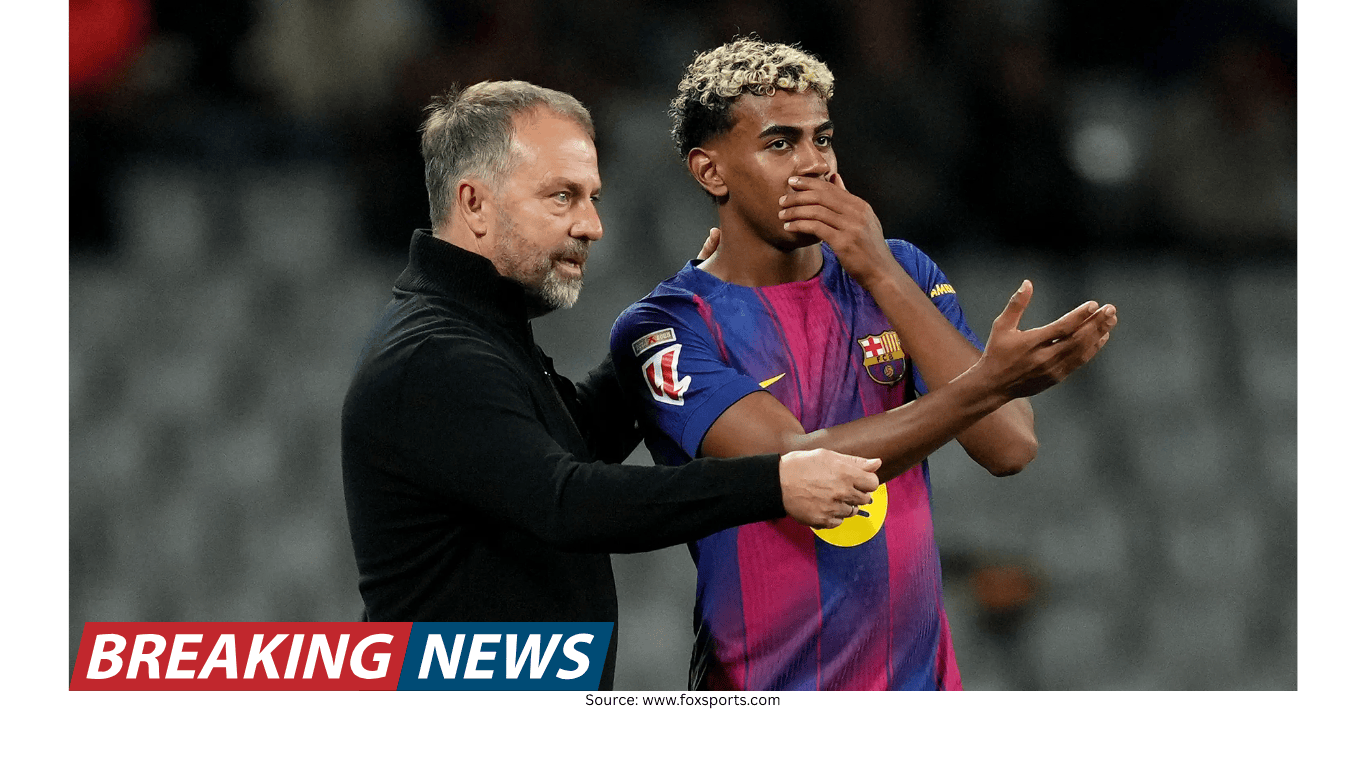
Flick responds to scrutiny over Yamal’s withdrawals
Barcelona head coach Hansi Flick has pushed back against what he described as the “noise” surrounding his decision-making, after teenage winger Lamine Yamal appeared visibly frustrated when substituted in recent matches. The discussion intensified following a clash with Levante, when cameras caught Yamal reacting angrily as he made his way off the pitch.
Flick, however, has framed the episode as routine rather than alarming. He described the youngster’s response as “normal,” presenting it as a reflection of competitive instinct rather than a deeper issue. In his view, the attention is less about the act itself and more about the environment in which it happens: at Barcelona, every gesture and every tactical choice can become a talking point.
With the German coach set to reach a personal milestone of 100 games in charge this Saturday against Villarreal, he has spoken about how scrutiny comes with the job. In comments to the club’s official media channels, Flick acknowledged that the club’s stature amplifies everything around it, including substitutions, facial expressions, and brief moments that might pass unnoticed elsewhere.
“Everyone is watching Barca”: why small moments become big stories
Flick’s central argument is that the scale of attention around Barcelona can distort how ordinary football moments are interpreted. He said that in Barcelona, “if a player or a coach says or does anything, it generates a lot of noise outside.” According to Flick, that constant observation changes the tone of public discussion, especially when the focus shifts from football to reactions and interpretations.
He also reflected on how quickly narratives can form. Flick suggested that at the beginning, “it seemed as if everything was negative because of the comments,” before adding a reminder of what he believes the sport should represent. “Football is to be enjoyed, in a positive way,” he said, positioning his response as an attempt to lower the temperature around routine decisions.
In practical terms, the coach appears to be asking for perspective: substitutions are part of the sport, and the emotional response of a player who wants to stay on the pitch is not unusual. What changes at Barcelona, in Flick’s telling, is the intensity of the spotlight.
Rotation, reactions, and the collective message
Flick defended his right to rotate his squad, even when that involves one of the club’s most exciting young talents. He noted that when he substitutes Yamal, there is a particular kind of attention paid not only to the tactical reason but to the player’s body language afterward.
“Here at Barca we already know that if I substitute Lamine they look to see what he does, his reaction, when this is part of the game,” Flick said. He added that it is “normal that being a footballer when you leave the pitch you are not satisfied,” but stressed that substitutions also reflect opportunity and fairness within the squad: “in the end there is also another player who deserves to play and you have to accept it.”
While standing firm on the principle, Flick also showed empathy, saying he can understand the feeling behind the reaction. The stance is twofold: he accepts that competitive players want to play every minute, but he insists that the team’s needs and squad balance must come first.
In that context, Flick’s comments can be read as an attempt to protect both the player and the group. By calling the reaction normal, he reduces the risk of the moment becoming a defining storyline. By emphasizing the collective, he sets a standard for how decisions should be interpreted: as part of a wider plan rather than a personal judgment on any individual.
A young core, a shared identity, and what Flick says makes Barcelona “different”
Beyond the immediate substitution debate, Flick spoke at length about what he enjoys in his current squad, highlighting the number of players who have come through La Masia. He expressed delight at working with a group he sees as united, describing their behavior as a key strength.
Flick pointed to the way young players such as Yamal, Pau Cubarsí, and Marc Bernal “act in the same way, as a team,” calling that unity “the most important thing” and describing it as something that “makes Barca different.” His emphasis was not simply on talent, but on habits: training at full intensity and carrying that standard into matches.
He also described his role in developmental terms, saying that “the most important thing are the players and the coaches are here for them, to help them do better, to grow, so that there is competition on a daily basis.” It is a statement that places coaching as a service to player improvement, while also underlining the need for internal competition within the squad.
Flick offered a small but telling observation about the group’s culture: he said he was surprised by how they celebrate, even after a win, when they “take a photo.” For him, it reflects a squad that values competing and celebrating moments when they feel they have performed well together.
- Flick says the club’s profile magnifies every decision and reaction.
- He describes Yamal’s frustration as normal, while insisting other players also deserve minutes.
- He highlights La Masia graduates as a cohesive unit and emphasizes daily competition.
- He links Barcelona’s identity not only to winning, but to how the team wins.
The Copa del Rey challenge: belief in a comeback after a 4-0 deficit
While the discussion around substitutions has dominated headlines, Flick’s immediate competitive focus includes a daunting task in the Copa del Rey. Barcelona trail Atletico Madrid 4-0 in their semi-final tie, and Flick has said the comeback is difficult but still possible.
“It’s difficult, but not impossible,” he said, placing belief at the center of the team’s approach. “We have to believe, that's the first thing.” Flick added that he feels his team is “capable of coming back and giving everything for 90 minutes or more.”
His language was direct and motivational, emphasizing commitment to the collective cause: “We have to fight for the team, for the club, for the fans.” The reward, he suggested, would be significant: “Reaching the Cup final would be almost a dream.”
Even without detailing tactics, Flick’s framing makes clear what he sees as essential ingredients: conviction, maximum effort over the full match, and a sense of shared purpose between players and supporters. The message is not that the comeback is likely, but that it is achievable if the team and the environment align.
Camp Nou and the importance of connection with supporters
Flick has also singled out the role of the stadium atmosphere, describing Camp Nou as vital for the second leg on March 3. His comments focus on the idea of “connection” between the stands and the pitch, suggesting that emotional momentum can be a factor when attempting something extraordinary.
“That's why Camp Nou is so important,” he said, before adding: “Playing at home everything is possible.” Flick stressed that when there is a strong bond between team and fans, the experience can be powerful: “When there is a connection between the team and fans it is great.”
He called on supporters to come and enjoy the occasion, reinforcing his earlier point about football being experienced positively. “We will need it on 3 March,” he said, underlining that the comeback attempt is not only a test of players but also of collective energy. “Everything is possible if we are together,” Flick added.
In Flick’s telling, the match is not just a tactical problem to solve but a shared event. The coach appears to be inviting supporters into the story, framing their role as part of the conditions needed to challenge a heavy deficit.
Milestone match against Villarreal and a wider view of the season
Flick’s upcoming 100th game in charge, set to come against Villarreal, provides a moment of reflection as well as a marker of continuity. While he said he approaches the job “match by match, day by day,” he also indicated that planning extends beyond the immediate fixture list.
Barcelona are competing across competitions and, as Flick put it, “we want to win titles.” Yet he also described the importance of looking ahead: “it is also important that in this club we are looking ahead to next season and for everything that will come.”
In that context, he praised the work of sporting director Deco as well as his own staff. “I really appreciate the work of Deco, of my staff,” Flick said, linking that support to his ability to focus positively on what comes next. He added that for him it matters “to look positively at the future” and “to feel the confidence.”
The combination of short-term focus and long-term planning is a familiar theme in elite management, but Flick’s comments suggest he sees both as necessary at a club like Barcelona, where expectations are constant and the margins for error are thin.
Laporta’s message: results matter, but so does the way Barcelona wins
Flick also recalled guidance he received from club president Joan Laporta when he arrived. The message, he said, was not only about winning but about understanding what Barcelona represents: “You must know what FC Barcelona means, its identity, its style of play.”
He added that Laporta told him on the first day that “you don't just have to win, it also matters how you win.” Flick said that principle aligns with his own beliefs, reinforcing that the club’s demands extend beyond the scoreline into performance and identity.
That philosophy provides a backdrop to the current debates around substitutions, squad rotation, and the management of young stars. In Flick’s framing, the coach’s job is to balance development and competition, individual ambition and team needs, and immediate results with the club’s broader identity.
What Flick’s comments reveal about Barcelona’s current moment
Flick’s response to the attention around Lamine Yamal is, ultimately, a statement about the realities of managing at Barcelona. He accepts that the club’s profile ensures every decision is examined, but he rejects the idea that such scrutiny should define the narrative or undermine the enjoyment of the sport.
His defense of rotation is paired with an acknowledgment of player emotion, and his praise for the squad centers on unity, competition, and a shared approach among young players rising together. At the same time, Barcelona face a major competitive challenge in the Copa del Rey, where Flick is urging belief and togetherness ahead of a difficult second leg.
As he approaches his 100th match in charge, Flick has presented himself as calm under pressure, focused on both the next game and the longer-term direction of the club, and mindful of Barcelona’s identity-driven expectations. In a setting where “noise” is inevitable, his message is that the team’s work, and the way it is done, should remain the priority.